Broken Mirror Spiritual Meaning: What It Actually Means and What to Do Next

The broken mirror spiritual meaning is not a single verdict from fate. Across different traditions, a broken mirror is read as one of three things: a release of stored energy, a marker of transition, or a disruption in the home's spiritual balance that can be addressed. Breaking one does not automatically mean seven years of bad luck — and what you do next matters far more than the break itself.
The sharp sound, the suspended moment, the rush of something half-remembered — a broken mirror hits differently than a dropped glass or a cracked plate. That reaction is not irrational. Mirrors have carried symbolic weight in nearly every culture for thousands of years, and the superstition about bad luck is only the most recognisable layer of that weight. Below it are older, more varied, and in some ways more useful readings.
Here is what those traditions actually say — the interpretations, the twelve "messages" people attach to the glass, the seven moments a break feels like an omen, and a clear plan for what to do afterward.
Why a Broken Mirror Feels Different From Other Accidents
Before mirrors were mass-produced, they were expensive enough to change the social hierarchy of rooms. A Venetian mirror in the 1600s could cost as much as a major painting. Royalty paid enormous sums; ordinary people often went entire lifetimes without owning one. The earliest known mirrors were polished obsidian, found in Anatolia and dating to approximately 6000 BCE. Polished copper mirrors appeared in ancient Egypt around 3100 BCE.
That history matters because the symbolic weight that built up around mirrors over those millennia did not disappear when mass production made them affordable. Culturally, a mirror is not neutral glass. It is the object that shows you your own face — which is, for most of human history, an unusual and somewhat charged experience. When one breaks, the emotional response draws on thousands of years of accumulated meaning.
Psychologically, a mirror confirms that you exist in the room. When the image fractures, many people feel a jolt that reads as more than inconvenience — something about continuity, self-recognition, or identity registers as briefly disrupted. That unease is where superstition and spiritual meaning both start. Both are, at root, frameworks for making sense of an event that already feels meaningful before any tradition weighs in.
Broken Mirror Spiritual Meaning: Seven Interpretations
Different traditions say different things about this. What follows is a fair summary of the main readings, without ranking them or claiming one is more correct than the others.
1. End of a cycle. The most common spiritual reading across multiple traditions: something in your life has run its course. A relationship, a phase, a self-image you have been holding. The break is less a punishment and more a marker — a visible signal that a before-and-after moment has arrived.
2. Release of accumulated energy. Several energy-based frameworks, including certain Feng Shui interpretations, treat mirrors as objects that absorb and hold the energy of the space and people around them. When a mirror breaks, it may be releasing energy that had built up over time — both stagnant and otherwise. Less destruction, more clearing.
3. A warning or nudge. Some traditions read a broken mirror as a signal to slow down, pay closer attention, or reconsider a decision in progress. Not a curse — more like a punctuation mark in the ongoing text of daily life.
4. Protection from negative energy. In parts of Eastern Europe and Latin America, folk belief holds that a mirror sometimes breaks because it absorbed a negative force directed at the household — taking a hit so the person did not have to. In this reading, the broken mirror is an act of protection.
5. Fracture in self-image or relationships. Mirrors belong to perception. A break can symbolise cracks in self-esteem, identity, or a partnership — especially if the mirror was shared or had long personal history. The question it raises is direct: who do you see, and does that image still hold?
6. Spiritual awakening through disruption. Several traditions treat breakdown as a condition of renewal. The break can be read as a call to stop clinging to surface appearances and look inward — what some frameworks describe as a forced pause before a significant shift.
7. Karmic movement. Some teachers interpret a broken mirror as a marker of karmic completion: old cycles closing, lessons wrapping up, new agreements beginning. Less an ending than a turning point.
None of these interpretations is established science. All of them are cultural and spiritual frameworks that people have found useful for making sense of an unexpected event. The value is less in whether they are "true" and more in whether they prompt the kind of reflection the moment is already inviting.
The Broken Mirror Spiritual Meaning Behind 12 Common "Messages"
Spend ten minutes searching and you will meet the same listicle in a dozen costumes: the twelve spiritual messages of a broken mirror. The number is tidy, not cosmic. Treat each one as optional language — a prompt for honest reflection, not a marching order from the universe.
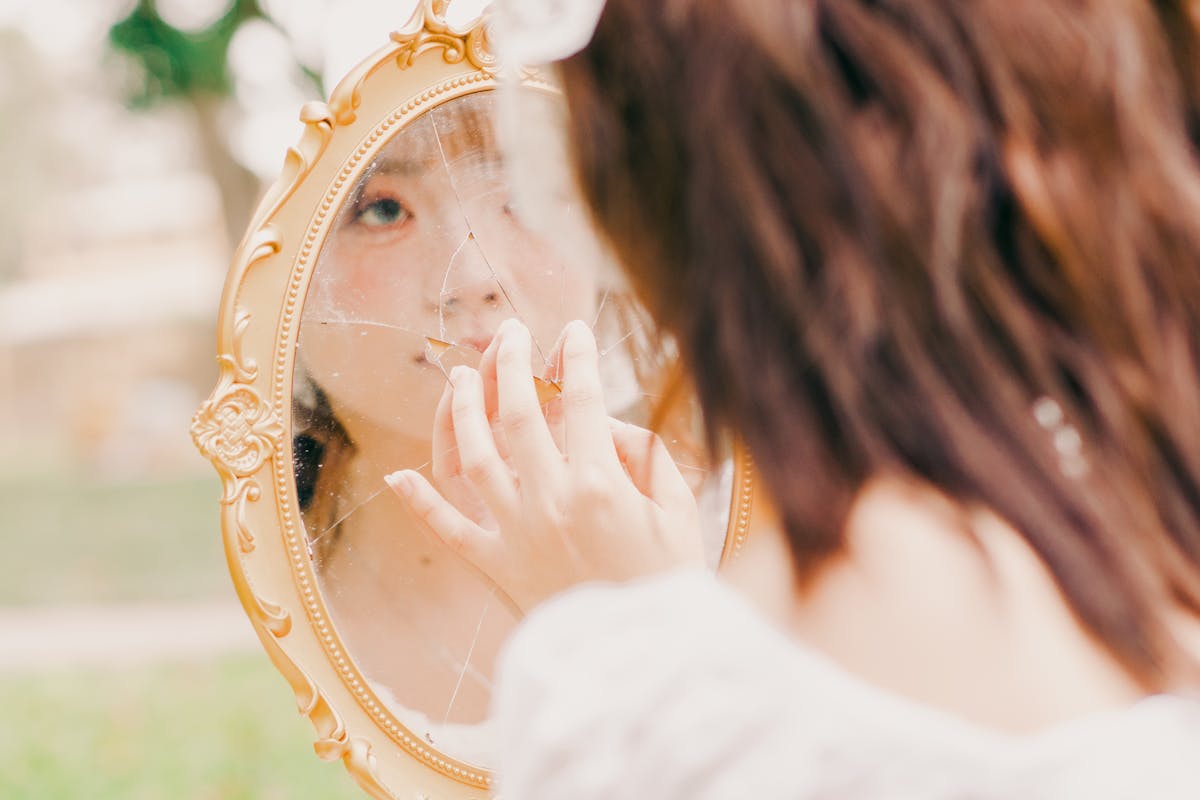
- Fractured self-image. Separate shards suggest several selves at once — or none that feel cohesive. A counsellor would call it narrative stress; folklore calls it an omen. Both notice the same discomfort.
- An illusion snapping. A polished surface holds until authenticity kicks the frame. The break can symbolise a mask slipping or a secret breaking open.
- A protective sacrifice. In the imagination where mirrors face outward to turn harm aside, a break becomes the object soaking a blow so you did not have to.
- A postponed transition. If a move, a breakup, or a grief milestone already loomed, the mirror becomes a loud calendar notification.
- Released stagnant energy. Some Indian folk readings welcome accidental breakage as pressure leaving the home — the mirror version of opening a window after an argument.
- Truth without polish. If you were bargaining with reality, no more symmetrical reflection can read as no more softened edges.
- Relationship fault lines surfacing. A shattered bathroom mirror coinciding with rising tension invites metaphor — invite being the operative word.
- Forced pacing and humility. Breaking what flatters can read as the cosmos tapping the brakes on hurry or vanity.
- Grief insisting on being witnessed. Sudden fractures echo how loss breaks expectations; many mourning rituals involve breaking vessels for exactly that reason.
- Shadow language about inner splits. Some readers map shards to fragmented inner parts asking for dialogue. Keep it tentative — therapy integrates better than glass.
- Creative interruption, then regathering. Artists fetishise cracks for a reason; a blockage breaking can clear the way for a new form.
- An open door to a new chapter. If "next chapter" language helps you drop fatalism without sliding into toxic positivity, use it. If it does the opposite, set it down.
The honest read on all twelve: humans are pattern-finders. Neuroscience calls part of this apophenia — meaning manufactured by an overeager linkage engine, amplified by stress. That does not make the reflection worthless. Symbolism plus a grounded next action still helps. Symbolism that curdles into self-punishment does not.
Where the "Seven Years Bad Luck" Belief Actually Came From
The honest answer is: ancient Rome, with a long journey through European folklore before it reached its current form.
Romans believed that mirrors did not merely reflect appearance — they captured something of the soul. They also held that the soul renewed itself on a seven-year cycle. Breaking a mirror, in this framework, damaged the soul's image badly enough that a full seven-year cycle was needed for complete recovery. That is the origin of the specific number — not superstition born from fear, but a coherent belief about the relationship between the physical body and the spiritual self, mapped onto a number that already carried cultural weight.
The superstition spread through Europe as Roman culture travelled. Historians writing at The Conversation trace how Greek and Roman ideas about reflection and harm combined with later European transmission — and how the proverb spread fastest once glass mirrors were mass-produced in the late 1800s, when breaking one was also genuinely expensive. By the time mirrors became cheap enough for ordinary households, the superstition had already embedded itself in folk tradition.
Many contemporary readers reframe the "seven years" not as a fixed curse but as a symbolic season — a period of change and recalibration. That reframing is consistent with the Roman original, which was about renewal rather than punishment. For the full lineage, the origin and history of the seven-year mirror superstition traces each step in detail.
What a Broken Mirror Means Across Different Cultures
Western superstition fixates on misfortune; elsewhere, the reading varies considerably. Understanding the range helps loosen the automatic dread.

| Culture or Tradition | Reading of a broken mirror | Typical response |
|---|---|---|
| Ancient Rome | Mirror captures the soul; break means seven-year damage until the soul renews | Remedies exist; reversible |
| Chinese Feng Shui | Mirror absorbs and directs chi; a shatter scatters energy or takes a hit for the household | Replace promptly |
| India (Vastu Shastra) | Disruption in prosperity and household order | Remove and replace promptly |
| India (some folk belief) | Good luck — releases accumulated negative energy | Positive; no action needed |
| Russian and Slavic | Heavier than bad luck — an omen of death or serious harm | High urgency |
| Japan (Kintsugi philosophy) | Breakage as an opportunity for beautiful, visible repair | Honour the damage |
| Japan (Shinto) | Sacred mirrors embody truth (the divine Yata no Kagami); breakage disrupts harmony | Reverence, not curse |
| West African and diaspora | Possible release, deflected harm, or completion of a working | Depends on context and intent |
| Jewish tradition | Breaking glass can be sacred (the wedding ritual); the curse is borrowed folk culture, not religious teaching | Acceptance |
| Ancient Maya | Cracked mirrors as channels to the world beyond — used on purpose, not feared | Ritual, deliberate |
Two entries are worth pausing on. In Japan, the art of Kintsugi repairs broken objects with gold lacquer, turning the cracks into the most celebrated feature rather than something to hide — a direct counterpoint to the Western curse. And for the ancient Maya, as researchers describe in this account of cracked Maya mirrors, a fractured reflective surface was not an accident to fear at all but a deliberate path for supernatural communication.

The pattern worth noticing: the same object carries opposite meanings in different cultural contexts. In ancient Rome, a broken mirror was among the worst accidents that could happen to you spiritually. In parts of India, the same event has been read for centuries as straightforwardly fortunate. The meaning is not in the glass. It is in the framework the culture built around glass. For the wider picture beyond breakage, the guide to mirror symbolism across world cultures and religions covers Islamic, Hindu, Buddhist, and indigenous frameworks in full.
Is a Broken Mirror Always a Sign or Omen?
The short answer is no.

An omen is an event interpreted as foreshadowing. Not every crack qualifies. Sometimes the drywall anchor failed. Sometimes the cleaning spray left the frame slick. Sometimes heat cycling weakened cheap adhesive over months and gravity finished the job.
Here is the single strong opinion this guide keeps on purpose: most broken mirrors are mundane physics wrapped in culturally trained symbolism. That sentence does not erase spirituality — it describes how humans layer worlds. A physical explanation can be true at the same time a spiritual reading feels true emotionally. They answer different questions: how the glass broke, versus why the meaning landed on you now.
If your only goal is safety and repairs, you never owe the universe an interpretation. If your goal includes spiritual discernment, treat the event as data for reflection — not as a court verdict you must obey without thinking. Timing is what tips a break from annoyance into omen. The same mirror on a quiet afternoon barely registers; the same mirror during a divorce filing, a frightening diagnosis, or the anniversary of a death can feel like it arrived with a message.
When a Broken Mirror Most Often Feels Like a Sign

These are seven high-salience contexts where people most often report reading a cracked mirror as an omen. None of them turn coincidence into proof — they explain why the interpretation latches.
- During or right after a major life decision. The mirror breaks while your cognitive load is already maxed, and the brain links salient events.
- In the middle of or just after an argument. Mirrors double the scene; raised voices plus flying objects equals symbolic overload before anyone mentions spirits.
- Soon after a death or during acute grief. Mourning narrows the world, and many cultures historically covered mirrors after a death — reflection feels spiritually loud when mortality is foregrounded.
- While you are fantasising about leaving a situation. Exit fantasies prime pattern detection, and the inner storyteller says you already knew.
- Repeated breaks in the same room or wall. Before reaching for spirits, check vibration from traffic, humidity warping cheap frames, or a door that slams the wall daily.
- Late nights or emotionally charged timing. Sleep debt and sensory contrast sharpen eeriness; fatigue and suggestibility are worth naming alongside any lunar reading.
- Multiple mirrors damaged close together. Rare in healthy homes — check manufacturing defects, movers, or children first, then decide whether you want a cleansing ritual after hazard control.
If your reaction is closer to fixation or panic than reflection, that is worth taking seriously on its own terms. Borrow structure, not dread: stabilise the hazard, name what you were feeling in the sixty seconds before impact, and choose one grounded action unrelated to symbolism.
What Does It Mean When a Mirror Breaks On Its Own?
A mirror that cracks with no one touching it feels like the most loaded version of the event — and it is the one readers ask about most after a sudden break.

Start with the physics, because it usually has the answer. Glass fails on its own for ordinary reasons: temperature swings between a cold wall and a warm room, a manufacturing flaw or trapped stress in the pane, humidity degrading the adhesive behind it, or a mounting bracket slowly losing its grip. A mirror over a radiator or in a steamy bathroom is a genuine candidate for spontaneous cracking, no spirits required.
Spiritually, a self-breaking mirror is read across traditions as the most emphatic version of the same three themes: a strong energetic shift in the home, a warning about a relationship or situation under the roof, or a protective object completing its work by releasing what it had absorbed. The grounded approach holds both layers at once — inspect the wall, the temperature, and the mounting first, and if the timing still lines up with something significant in your life, sit with the spiritual reading rather than letting it spiral.
Accidental vs. Deliberate — Does Intent Change the Meaning?
Most traditions distinguish between the two, and the distinction is worth making.
If you broke it accidentally: The event is generally read as synchronicity — something that happened around you, potentially meaningful but not carrying the weight of intention. The folk remedies for reversing bad luck are typically aimed at accidental breaks. If the timing aligns with something significant in your life, pay attention to what you were thinking about in the moment before it fell.
If you broke it deliberately: A deliberate smashing is an act of rejection — of an image, a relationship, or a chapter. In anger, it signals overwhelm; in intentional ritual, it may mark a decision to sever a tie or break a pattern. Either way, most traditions recommend more deliberate cleansing afterward, because the act concentrates emotional energy in one place that does not dissipate on its own.
The symbolic charge is real in both cases, but the appropriate response is different.
What to Do After Breaking a Mirror — Practical and Spiritual Steps
The practical steps matter as much as the spiritual ones. Glass shards cause real injuries; the spiritual work starts after the physical mess is addressed safely.

Immediately:
- Wear gloves and sturdy footwear before touching anything
- Avoid looking at your reflection in the shards — partly practical (risk of cuts), partly symbolic in most folk traditions
- Set a brief intention before you sweep: you are cleaning up deliberately, not in panic
Clearing the glass:
- Use a broom and dustpan — not a vacuum, which scatters fine shards invisibly
- Sweep toward yourself to contain the pieces before removing them
- Wrap the shards in paper or cloth; some traditions add a pinch of salt as a purifying gesture
- Dispose of them outside the home — folk logic holds that glass left on the property keeps the weight of the event close
After the glass is gone:
- Open windows to air the space and mark a reset
- Clear the area with smoke (sage, palo santo, or incense), sound, or sunlight
- Cover or replace the empty spot when you feel ready; some traditions wait seven days before rehanging a mirror as a nod to the superstition's original cycle
For a full list of folk remedies specifically aimed at reversing bad luck after a break, the 13 folk remedies for broken mirror bad luck guide covers the range from salt baths to burying the shards by moonlight.
How to Spiritually Cleanse the Space
The cleansing step is where the most variation exists across traditions — but several practices appear independently in enough cultures to suggest they are serving a real psychological and spiritual function.

Step-by-step reset:
- Stay calm while cleaning. Panic concentrates negative emotional energy in the space. Deliberate, unhurried movement does the opposite.
- Remove all glass. No fragments left behind — this is both physically necessary and symbolically complete.
- Cleanse with smoke. Burn sage, palo santo, or incense and move the smoke through the room, paying particular attention to the corners. Many traditions move counterclockwise to clear, then clockwise to welcome fresh energy.
- Salt the space. Place a small dish of sea salt in the room for 24 hours, then dispose of it outside. Salt appears as a purifying substance in folk traditions across dozens of cultures — from Roman to Irish to Chinese.
- Set an intention. Speak aloud, or clearly in your mind, what you are releasing and what you are welcoming. This is the most important step across all frameworks — the act of addressing the event rather than hoping it resolves on its own.
- Ground yourself. A walk outside, a salt bath, or simply sitting still for a few minutes before leaving the room. The goal is returning your nervous system to baseline before carrying the charged moment into the rest of your day.
The cleansing does not need to be elaborate. Its function is to mark the moment as addressed — to close the event rather than leaving it open-ended.
The Same Object, Two Opposite Meanings
There is a story worth knowing here. In some parts of India, a broken mirror is considered good luck — specifically, that it releases negative energy that had accumulated in the glass. The mirror, in this reading, has done its job and finished it.
The Roman tradition and the Indian tradition existed for centuries without either knowing the other's interpretation. Two cultures, the same object, opposite meanings — both held with equal seriousness across generations.
This is the most useful thing to remember when you are standing over a pile of glass feeling the first wave of unease: the meaning is not in the mirror. The mirror does not know it broke. The meaning is what a culture, over centuries, decided to build around the event — and cultures have built very different things. The seven-year belief is one answer. The good luck reading is another. Your own honest response to the timing and context of the break is also data.
When the Issue Is Mirror Anxiety, Not Superstition

This section is for a different reader — but it belongs here, because some of the people searching for "broken mirror spiritual meaning" are not primarily worried about bad luck. They are worried about their reflection.
If looking in mirrors has already been causing distress — if you avoid mirrors, feel relief when one breaks, or notice your unease about mirrors is growing rather than shrinking — the broken mirror is not the issue. The underlying anxiety is.
One reader described covering her bathroom mirror for six months after a period of intense self-criticism about her appearance. She found that the avoidance made things worse. The mental image of what she might see grew more distorted the longer she avoided looking. When she eventually worked with a therapist using gradual mirror exposure, what surprised her most was not what she saw — it was how far her mental image had drifted from her actual reflection.
Mirror avoidance makes anxiety worse, not better. This is well-established in clinical psychology. The mental image of what you might see expands to fill the space the real reflection vacates. If that pattern sounds familiar, the response is not more avoidance — it is gradual re-engagement, ideally with professional support. For the symbolic dimension of mirror dreams specifically — which often surface this same anxiety in sleep — the broken mirror dream meanings guide covers what those dreams tend to process.
The seven-year bad luck story gives you something external to blame for how you feel. Mirror anxiety asks a harder question: what is the relationship between you and your own reflection, and is that relationship working?
A broken mirror is an event. Its meaning is something you bring to it — gathered from whatever tradition you were raised in, whatever you were going through at the moment it fell, and whatever you choose to do next. That does not make the meaning less real. It makes it yours to work with.
The glass is broken. The clear action is to clean it up carefully, address the space with intention, and move forward without carrying the moment as a weight you were assigned rather than one you chose. The mirror is replaceable. Your sense of what the moment meant — and what you did with it — is not.
Frequently Asked Questions
What is the spiritual meaning of a broken mirror?
Different traditions read a broken mirror differently. In Western folk belief, it signals bad luck or misfortune. In several Eastern traditions, a shattered mirror can mean the object absorbed and released negative energy — protective rather than ominous. Most spiritual frameworks interpret it as marking a transition: the end of a cycle, a shift in self-image, or a disruption in household energy that calls for deliberate cleansing. The meaning depends heavily on context, timing, and which tradition you are drawing from.
Does breaking a mirror really bring seven years of bad luck?
The seven-year bad luck belief originated in ancient Rome, where mirrors were thought to capture a fragment of the soul and Romans believed the soul renewed itself every seven years. The superstition spread widely after mass-produced mirrors became common in the late 1800s, when breaking one was also genuinely expensive. Most contemporary spiritual teachers and cultural historians treat it as a belief worth understanding rather than a literal rule — a symbolic framing of change rather than a fixed curse.
What should I do immediately after breaking a mirror?
Practically: wear gloves, sweep the shards carefully with a broom and dustpan (not a vacuum, which scatters fragments), wrap them in paper or cloth, and dispose of them outside the home. Folk traditions suggest adding a pinch of salt to the wrapped shards before disposal. Spiritually: set a brief intention before you sweep, cleanse the space afterward with smoke or by opening windows, and replace the mirror when you feel ready. The key across all traditions is deliberate action rather than panic.
Is a broken mirror a bad spiritual omen?
Not necessarily. While Western superstition frames it as bad luck, several other traditions read it differently. In some Chinese Feng Shui frameworks, a mirror shattering can mean it absorbed a burst of negative energy directed at the household — functioning as a form of protection rather than a curse. In parts of India, a broken mirror is considered good luck, releasing accumulated negative energy from the object. Irish folklore in some variants associates a break with illness breaking its hold. Whether the omen is "bad" depends heavily on which tradition you consult.
Is a broken mirror always a sign or omen?
No. An omen is an event read as foreshadowing, and not every crack qualifies — sometimes a mounting bracket failed, adhesive aged, or temperature stress finished the job. Psychologists describe apophenia, the tendency to perceive meaning in unrelated events, which is why a break during a divorce, a diagnosis, or grief feels loaded while the same break on a lazy Saturday only annoys you. A physical explanation and a spiritual reading can both feel true at once; they answer different questions.
What does it mean if a mirror breaks on its own with no one touching it?
A mirror breaking on its own — due to temperature shifts, structural weakness, or mounting failure — is treated as especially significant in many spiritual traditions. Common interpretations include a strong energetic shift in the home, a warning about a relationship or situation in the household, or the mirror completing a protective function by releasing accumulated energy. Practically, check the mounting and environmental conditions first. If the timing aligns with significant events in your life, the spiritual reading is worth sitting with — but the physics usually has a straightforward explanation too.
Does dreaming of a broken mirror mean the same as breaking one in waking life?
Rarely one-to-one. A waking break often comes down to clumsiness or a loose bracket, while a dream exaggerates unfinished emotional work — a fractured self-image, a fear of betrayal, or a transition you have been postponing. Compare the storyline of the dream to recent stress rather than collapsing both into a single omen. Mirror dreams have their own symbolic language, covered separately in the broken mirror dream guide.
How do I cleanse my home after breaking a mirror?
After safely removing all glass, open windows to air the space. Burning sage, palo santo, or incense and moving the smoke through the room is the most common cross-cultural cleansing practice. Placing a small dish of sea salt in the room for 24 hours is used across several traditions to absorb residual energy. Speak a short intention aloud — something that names what you are releasing and what you are welcoming — before you leave the room. Replace the mirror, or cover the spot temporarily, when you feel the reset is complete.
Does it matter whether I broke the mirror accidentally or deliberately?
Most traditions distinguish between the two. An accidental break is generally read as synchronicity — something that happened around you, worth noting but not necessarily carrying the weight of intention. A deliberate smashing carries more symbolic charge: it is an act of rejection, anger, or severance, and most traditions suggest more deliberate cleansing afterward to address the concentrated emotional energy released. The folk remedies for reversing bad luck are typically aimed at accidental breaks; deliberate ones call more for inner work than ritual.