Mirror Dream Meaning: What Your Mirror Dreams Are Telling You

Mirror dream meaning is best read from one rule: a mirror in a dream is your subconscious working in its most direct mode. When a mirror appears in sleep — clear or cracked, showing your face or someone else's, reflecting nothing at all — it is almost never about your appearance. It is about how you see yourself: your identity, your self-honesty, and which truths you are ready or not ready to face. The condition of the mirror is the message. A clear reflection tends to signal self-acceptance and psychological clarity. A broken or foggy one typically points to something fractured or obscured in your self-perception. A mirror that shows no reflection at all is your subconscious registering identity loss. The details matter, and this guide works through all of them.
Mirror dreams are among the most psychologically loaded dream images a person can experience. They appear with unusual frequency during specific life moments: a relationship that is ending, a career that no longer fits, a significant birthday, a period of loss. The timing tends to be purposeful. If you woke from a mirror dream wondering what it meant, the meaning is almost certainly in the details of what the mirror was doing — or failing to do.
Why Mirrors Appear in Dreams: What Your Subconscious Is Working Through

Mirrors, in both waking life and dream symbolism, have always represented a specific kind of confrontation: the self looking at the self. Dream interpretation traditions going back to ancient Mesopotamia treated reflective surfaces as portals to hidden knowledge — not escape, but confrontation. The modern psychological interpretation shares the same core logic.
Three triggers appear most consistently in mirror dream accounts:
Identity pressure. A significant life change — a job loss, the end of a relationship, a major birthday, the death of a parent — forces a re-evaluation of who you are. The mirror in the dream is the arena where that evaluation happens.
Inauthenticity. If you have been performing a version of yourself that does not match your inner reality — playing a role at work, in a relationship, or in your social environment — your dreaming mind eventually demands a reckoning. The mirror is that reckoning.
Comparison and self-image anxiety. Periods of intense comparison to others, or sustained self-criticism, feed mirror imagery in dreams. The mirror becomes the place where the gap between how you appear and how you feel you appear becomes impossible to ignore.
Understanding what was happening in your life in the days before the dream usually tells you more than any symbol dictionary can. The mirror is the stage. Your life is the script.
What It Means to See Your Own Reflection in a Dream
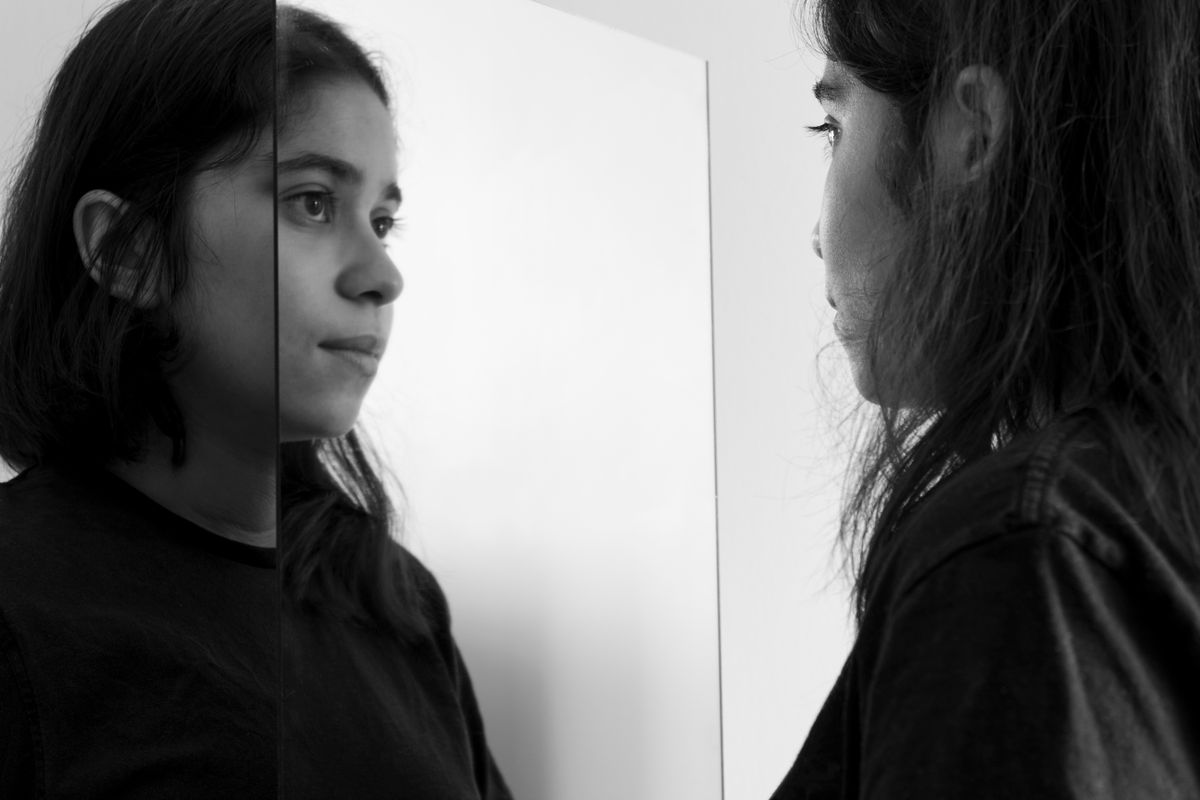
Seeing yourself in a dream mirror is the most common scenario, and what the reflection shows narrows the meaning fast. A clear, calm face tends to signal self-acceptance and a stable identity; a distorted or aged one, anxiety about a change you feel unprepared for; a younger face, grief or a wish to reconnect with values you left behind; and a face that is recognisably yours but subtly wrong, the strain of living inauthentically.
Your emotional reaction inside the dream is the most reliable guide — peaceful recognition suggests integration, unease suggests self-perception under strain. The full nine readings, with the research caveats, are in the seeing yourself in a mirror dream guide.
What a Broken or Cracked Mirror Means in a Dream

A broken mirror in a dream means something distinct from the waking superstition. The seven-years-of-bad-luck story is folklore from ancient Rome; in a dream, a broken mirror signals a fractured self-image — a picture of yourself that has not survived something intact, whether a betrayal, a failure, a loss, or the realisation that an old identity no longer fits. It is not a curse. The crack pattern adds detail (a single line for one fracture point, shattered glass for a more comprehensive break), and breaking it yourself, or picking up the pieces, points to active rebuilding rather than avoidance.
That is the short version. The nine full readings, the crack-versus-shatter distinction, and what to do when you wake are covered in the dedicated broken and cracked mirror dream guide.
What It Means When You Have No Reflection in a Dream

Standing in front of a mirror and seeing nothing is one of the more unsettling — and most specific — mirror dream scenarios. It signals identity loss: not a literal threat, but an accurate picture of having lost the thread back to your authentic self. It appears most in people who have been suppressing themselves for a long stretch, and during profound grief, when the loss of someone central to your sense of self makes the reflection simply vanish. It is not a diagnosis, but a starting point for one question: what would it mean to see yourself clearly again?
The eight readings of an empty mirror, and why some traditions say never look into a dream mirror, are covered in the no reflection in a mirror dream guide. A related variation appears in the mirror in water dream meaning guide.
Foggy, Dirty, or Clouded Mirrors: When the Dream Mirror Refuses to Show Clearly

Where a broken mirror signals a fracture, a foggy mirror signals confusion and temporarily obscured clarity. You know who you are — but something, grief, indecision, stress, a decision you cannot yet make, is misting over the view. The fog is the obstacle, not the self underneath it. Context decides the nuance: wiping it clear points to active movement toward understanding; fog that will not lift is the dream telling you to wait rather than force a conclusion. (A dirty mirror, grime rather than fog, points instead to a self-image left unexamined too long.)
Either way, these dreams are not saying something is permanently obscured — only that clarity is not yet available. The seven foggy-mirror readings and the wipe-it-clear test are covered in the foggy mirror dream meaning guide.
Seeing Someone Else in the Mirror: What These Dreams Are Processing
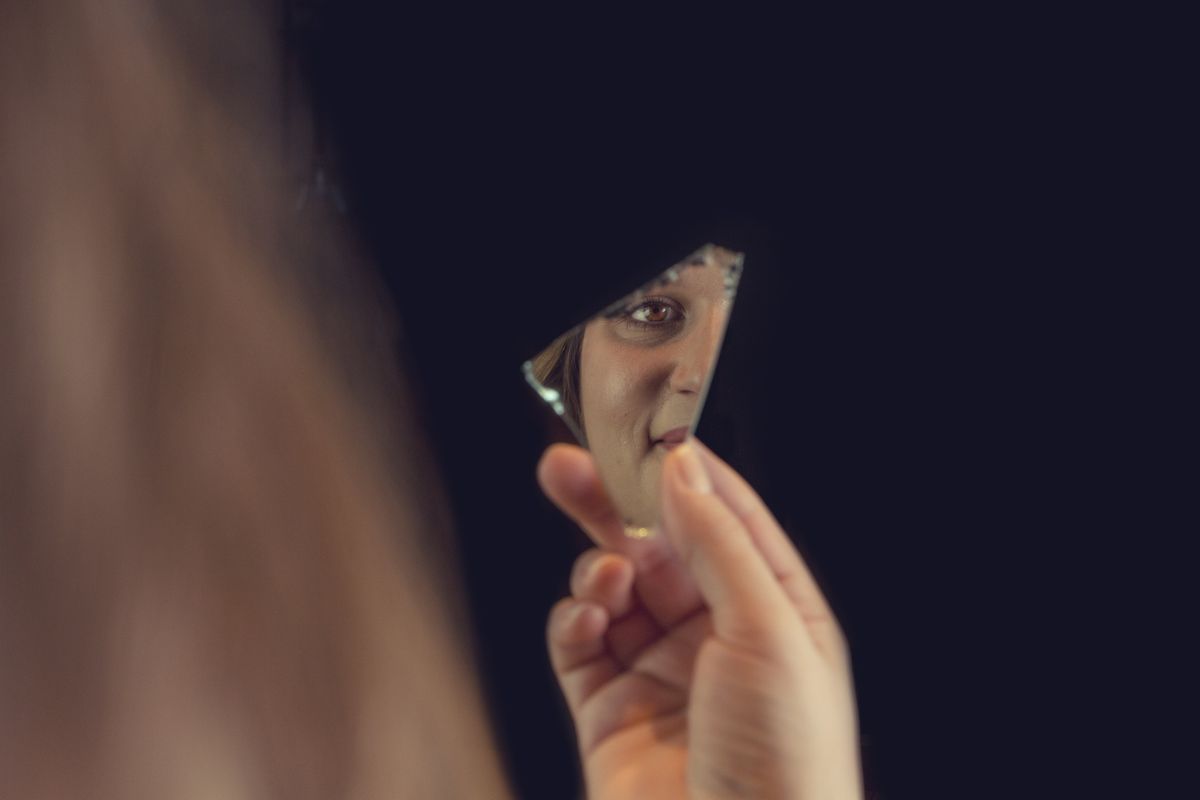
A mirror that shows someone else's face instead of your own usually runs on one of two dynamics. Projection: the face is showing you qualities you have suppressed or are attributing to that person when they actually originate in you — Jung's shadow material, appearing where your own face should be. Identity suppression: if it is someone you have been over-adapting to (a demanding partner, a parent, a workplace culture), the dream is registering that their version of you has displaced your own. The emotional tone tells you which — fear points to suppression, calm often to a positive projection.
The full reading by who appears (a deceased loved one, a stranger, a younger self, a threatening figure) is in the someone else in a mirror dream guide.
What Freud and Jung Said About Mirror Dreams — and What Still Holds Up

Both Freud and Jung interpreted mirror dreams, and both frameworks remain useful — with different emphases.
Freud saw the mirror as an ego symbol. Dreaming of your reflection, in his view, relates to self-examination, vanity, and the gap between the idealised self-image and the reality. The mirror dream was the ego confronting itself — and the discomfort in the dream reflected the discomfort of that confrontation.
Jung's reading is richer and has held up better in clinical practice. He interpreted mirrors as a direct line to the shadow self — the parts of your personality you have buried because they felt unacceptable, dangerous, or incompatible with who you believe yourself to be. The face staring back from the dream mirror may not be comfortable to see. But Jung believed that integrating the shadow — looking at it, acknowledging it, accepting it as part of yourself — was the path to psychological wholeness, not the threat. The mirror dream, in his framework, is an invitation, not a curse.
According to Psychology Today's overview of dreaming, contemporary sleep research broadly supports the idea that dreams process emotional material accumulated during waking life — which aligns with both Freudian and Jungian interpretations, even as the underlying mechanisms are understood very differently today.
The honest answer is that both frameworks are interpretive tools, not diagnostic facts. Mirror dreams do not mean the same thing to every person. What they do reliably signal is that something about self-perception is active in your psychology right now — and the specific images your dream produced are your subconscious's attempt to show you what.
Mirror Dream Meanings Across Religious and Spiritual Traditions

Different traditions read mirrors in dreams differently — and covering only one while ignoring the others is selection bias. Here is what the major frameworks actually say.
Christianity. The most cited reference is 1 Corinthians 13:12: "For now we see through a glass, darkly; but then face to face." In Christian dream interpretation, a mirror often represents partial, limited understanding — a call to humility before divine clarity and to deeper self-examination before God. James 1:23–24 compares someone who hears the word but does not act on it to a person who looks in a mirror and immediately forgets what they saw. The mirror becomes a prompt for reflection that carries beyond the moment.
Islam. Islamic dream interpretation (ta'bir) views a clear mirror as a positive sign — clarity, honesty, and a pure heart. A broken mirror may signal the end of a relationship or approaching conflict. Seeing a stranger's face in your mirror can warn of deception from someone close. The condition and clarity of the glass are the central interpretive elements.
Hindu tradition. Mirrors in Hindu dream symbolism relate to maya — the concept of illusion. What you see in the dream mirror may not be the full truth. The dream may be asking you to look past surface appearances, in yourself as much as in the world around you.
West African and diasporic traditions. In certain traditions, mirrors serve as communication tools between the living and ancestors. A mirror in a dream that carries an unusual sense of presence or significance — a feeling of being seen, or a sense that the reflection is something other than your own — may be interpreted as contact with or a message from the spirit world.
The pattern across these traditions is worth noting: in almost every cultural framework, the mirror in a dream is not passive. It is active, truth-telling, and calling for a response. For a fuller treatment of how mirrors function as spiritual tools beyond dream interpretation, the mirror as a spiritual tool guide covers the cross-cultural breadth in detail.
Why You Cannot See Yourself Clearly in a Mirror in a Dream: The Neuroscience

This is one of the more commonly searched mirror dream questions, and it has a genuine neurological answer that most articles skip.
During REM sleep — the stage where most vivid dreaming occurs — the brain regions responsible for self-recognition work differently than in waking life. The right temporoparietal junction, which is central to stable self-image and self-perception, has reduced activity. Your brain is running a simulation of the world that includes a version of you, but the self-recognition machinery is operating at reduced capacity. A stable, clear reflection of your own face is neurologically harder to generate in REM sleep than it is when you are awake.
This is why mirrors are used as reality-check tests in lucid dreaming practice. According to Sleep Foundation research on dreaming, lucid dreamers — people who become conscious that they are dreaming while still in the dream — are trained to look at their hands or look in a mirror, because both tend to appear distorted or unstable in dreams. If you look at your reflection and it is strange or shifting, that is a reliable signal you are dreaming.
The symbolic and the neurological intersect here in a genuinely interesting way. The instability of the mirror image is both a product of how the sleeping brain processes self-image and, when experienced as meaningful, a prompt toward self-examination. The neuroscience does not invalidate the symbolic reading. It explains why mirrors are such unusually potent dream images in the first place.
Mirrors as Reality-Check Triggers in Lucid Dreaming: A Dimension Most Guides Miss
Most mirror dream articles do not cover this angle, but it is worth understanding if you experience frequent or vivid mirror dreams.
In lucid dreaming practice, mirrors are among the most commonly used reality-check triggers — techniques dreamers use to test whether they are awake or asleep. A mirror that shows the wrong face, a distorted image, or a reflection that moves independently is a high-confidence signal that the dreamer is in a dream state. Once recognised, this can initiate lucid awareness — the capacity to navigate the dream consciously.
Some experienced lucid dreamers deliberately engage with mirrors in their dreams rather than reacting to the unsettling imagery with alarm. They approach the mirror with deliberate curiosity: who or what is in the reflection, and what does the interaction with it reveal? This is an active form of the self-examination that mirror dreams invite — using the instability of the image as an entry point rather than an obstacle.
If your mirror dreams are vivid and recurring, keeping a dream journal with specific attention to what the mirror shows, how it behaves, and what your emotional response is within the dream will produce more useful insight than any general symbol reference.
What to Do When Mirror Dreams Keep Recurring
Recurring mirror dreams carry a specific logic: the same message is returning because it has not yet been addressed. Your subconscious is persistent in this way. It will use the same image — the same broken mirror, the same absent reflection, the same distorted face — until the underlying question gets enough conscious attention that it no longer needs to surface at night.
Four concrete responses that actually help:
Write the dream down immediately. Capture the mirror condition, what you saw or did not see, your reaction within the dream, and the emotional tone you woke with. Do this across multiple dreams. The pattern across entries — not the single instance — is where the meaning tends to live.
Ask the right question. Not "what does this dream mean?" but "what am I not seeing about myself right now?" Not a critical question. A genuinely curious one. The answer is usually already known, at some level — the dream is a prompt to bring it into the open.
Notice when the dreams cluster. Recurring mirror dreams often intensify during specific relationships, jobs, or life phases. That timing is not coincidental — it is the context the dream is responding to.
Seek support if the dreams are disturbing. Recurring distressing mirror dreams — particularly those involving violence, complete identity loss, or imagery that wakes you with lasting anxiety — are worth addressing with a therapist. Dream work in a therapeutic context can be genuinely productive, particularly for people whose mirror dreams feel connected to deeper questions about self-image or identity.
The mirror in your dream is not a threat. It is the most honest conversation your sleeping mind knows how to have with you. For those interested in how mirrors carry symbolic weight across cultures and spiritual traditions beyond the dream context, the guide to mirror symbolism across world cultures and religions covers the full picture.
Most people look in thousands of mirrors across a lifetime without thinking twice about what they see. A mirror in a dream is different. It appears because the sleeping brain is using the most direct visual symbol it has for self-confrontation — placing you in front of your own reflection, in all its possible conditions, and waiting to see what you do with it. The image you remember on waking — cracked, foggy, missing, showing someone else — is worth following back. It is almost always pointing at something specific, and specific is the most useful place to start.
Frequently Asked Questions
What does it mean when you dream about a mirror?
A mirror in a dream typically represents self-perception, identity, and inner honesty. The condition of the mirror matters: a clear mirror points to self-awareness and clarity, while a broken, foggy, or distorted mirror reflects confusion, fragmented identity, or truths you are avoiding. Mirror dreams are especially common during periods of personal transition, identity stress, or unresolved emotional conflict.
What does it mean to see yourself in a mirror in a dream?
Seeing your own reflection in a dream is your subconscious staging a direct confrontation with self-perception. A clear, recognisable reflection suggests self-acceptance. A distorted, aged, or unfamiliar reflection points to identity anxiety or resistance to change. The emotional tone on waking is your most reliable guide: calm means integration; unsettled means something about your self-image needs attention.
Is dreaming of a broken mirror bad luck?
In waking folklore, a broken mirror signals seven years of bad luck — a belief traced to ancient Rome, where Romans held that mirrors captured part of the soul. In dream interpretation, a broken mirror represents a fractured self-image or a shattered illusion, not a literal curse. It often appears after events that challenged your sense of identity. Dreaming of picking up the pieces is usually a sign of active psychological rebuilding.
What does it mean to dream of having no reflection in a mirror?
Standing in front of a mirror and seeing nothing points to identity loss, feeling invisible, or living so far outside your authentic self that your subconscious has stopped recognising you. It is common in periods of emotional suppression, burnout, or when you have been performing a version of yourself that does not match your inner reality.
What does a foggy mirror mean in a dream?
Fog or cloudiness in a dream mirror signals that clarity is not yet available. Something — grief, indecision, burnout, or a major change — is obscuring the view. If you wipe the mirror and it clears, the dream points to active effort toward clarity. If the fog remains despite your efforts, your subconscious is telling you to wait rather than force a conclusion.
Can a mirror dream have a spiritual meaning?
Yes. Across traditions from Christian scripture to Islamic dream interpretation to Hindu philosophy, mirrors carry spiritual significance in dreams. A mirror in a dream can signal a call to honest self-examination, a message from your deeper self, or a threshold between the conscious and unconscious. The sense of significance or presence you feel on waking is often your best guide to its spiritual dimension.
Why do I keep having recurring mirror dreams?
Recurring mirror dreams signal that an unresolved issue about identity, self-perception, or authenticity keeps returning to consciousness because you have not yet addressed it. Keeping a dream journal to track what changes across each instance — the mirror condition, your reaction, the emotional tone — often reveals the pattern your subconscious is trying to show you.
What does it mean when you see someone else in a mirror in a dream?
Seeing another person in the mirror instead of yourself usually points to two dynamics: either you are projecting their traits onto yourself, or you have been suppressing your own identity to accommodate their expectations. It can also signal that you are playing a role that does not reflect your authentic self. The specific person and your relationship to them often reveals which dynamic is at play.